IF YOU FEEL THAT YOU ARE IN IMMEDIATE DANGER, PLEASE CALL YOUR LOCAL EMERGENCY NUMBER
For everyone else, including those curious about doxing and those who have already been targeted, the following is a primer on the realities, pathology, and personal solutions for this particularly nasty form of online harassment.
What is doxing? Have I really been doxed?
Doxing (named for documents, or “dox”) is the public release of someone’s private information. Some argue over what constitutes a legitimate “dox” because of how freely available personal information is online, but at Crash Override, we use the following definition:
“Doxing is the act of publishing someone’s personal information, of which there would be a reasonable expectation of privacy and dubious value to the conversation, in an environment that implies or encourages intimidation or threat.”
This includes information that may arguably be easy to find, such as a home address from a WhoIs lookup or personal photos from Facebook, so long as it is wielded in a threatening manner – for instance, tweeted at someone in response to a disagreement. Doxing is less about the availability of the information, and more about the way it is used to intimidate or harass a target.
Of all forms of online harassment we observe at Crash Override, doxing is one of the most prevalent due to its relative ease and high emotional impact. For harassers, the pathology behind doxing is about rationalizing oneself as “blameless” for pawning off personal information for others to harass with. The person who paints a target on you might not be the one to act on it, but the message is clear: “I can’t be held responsible for what happens next.” Aside from intimidation, harassers will often use dox to create the illusion that they have totally invaded your personal space, even if their information is of limited value or inaccurate.
The most common response to being doxed is fear, if not outright panic. Feeling vulnerable is entirely understandable. Doxing is intentionally designed to violate your sense of security and cause you to panic, lash out, or shut down.
If you find yourself in this position, there’s a lot to consider. Our goal with this guide is to help you navigate your options and better understand your situation. Of course, if you feel you still need advice, please email us at crashoverridenetwork@gmail.com for personalized assistance.
I’ve been doxed – what do I do?
Before you do anything, remember that documenting your doxing is of the utmost priority. Things like screenshots, downloading the webpage, web archive (e.g. https://archive.org/web/ or http://archive.today/ – though it should be noted that using public services like this will make your dox viewable to others using that service), and other methods of record-keeping, preferably with things like timestamps and URLs visible, are crucial for both your own reference and for any third parties who may have an interest in your case. Not only does it create a chain of culpability, but the site of your doxing and surrounding threats can make it much easier to secure police or legal involvement should the harassment escalate.
This doesn’t mean you should leave your dox up if you can help it. Once it’s documented, sites like Pastebin, which are often used to share doxed information, have procedures in place (http://pastebin.com/contact) for removing private information. Twitter has also recently made doxing a violation of their TOS (http://gizmodo.com/twitter-just-banned-revenge-porn-and-doxing-1690916107), and accounts used to harass in this manner can often be reported and the offending posts removed.
When you get doxed, panic can set in quickly. There is no “right” way to feel, as your state of vulnerability and what your personal information means to you is different from person to person. Whatever your initial response to being targeted may be—fear, anxiety, anger, confusion, helplessness–it is a valid and reasonable response to have in the face of such things. Don’t beat yourself up over it, and don’t worry about whether or not your reaction was the right one.
If you don’t feel you are at any great risk, and especially if your dox is comprised of freely-available information and/or sent directly to you in an effort to unnerve you, you may feel fine dismissing it as a cheap intimidation tactic, blocking/reporting the harasser, and moving on. This is often someone just trying to get a rise out of you. However, if your dox contains sensitive personal information, especially things that are hard for people to sniff out with simple detective work, or appears in a public forum where people distribute dox to have others act on it, you may want to take further precautions. This is especially true for marginalized people, especially in the case of trans people who have been deadnamed due to the greater risk of violence that trans people face in society at large.
Do I go public with it?
The first impulse you might have is to immediately alert as many people as you can with a public announcement – in fact, harassers usually intimidate their targets into not publicizing their harassment to deny them needed support. Officers will generally not tell you to stay silent about harassment. This is purely a victim-blaming and silencing tactic. The choice to go public and let people know about your doxing is a personal decision. Going public can expose you to immediate support if you have a sympathetic audience, but carries the risk of increased aggression from harassers. Not everyone has the time, energy, inclination, or freedom to bear further harassment (and, indeed, no one should have to).
There are some good arguments to be made for being initially cautious with information – While sharing your story can bring you support, the most important thing to do right now is to secure yourself in order to not expose yourself to further harm. Immediate announcements can trip up your security efforts – Whether or not the information posted about you is accurate, no one is likely to use it to cause you any serious harm without first confirming at least some part of it. Posting “I’ve just been doxed!” on a social media account immediately provides not only a confirmation that your information is accurate, but that you have seen where it was posted, and are properly terrified.
Denying the veracity of any information posted about you can be just as bad. This still confirms that your harassers have gotten your attention, and signals to them that they just need to keep digging. Sometimes, one of the most effective initial public responses is no response at all – don’t make any major changes to posting habits, or visibly show any fear if you can help it. This sends the message that your doxer probably missed the mark, and that the attack was a failure.
You should, however, prepare for more active efforts at verification. Usually, but not always, harassers will test the waters by calling whatever phone number is posted and asking to speak with you, or sending you emails/social media messages in hopes you’ll respond. Keep in mind, however, that with this sort of crowdsourced harassment, multiple unconnected parties may attempt this.
Evaluating Doxing Threats
Upon being made aware of a dox, it’s important to establish what information may translate into credible threats. Oftentimes, doxing is a precursor to more intrusive offline harassment, or comes paired with threats to act on the information revealed. The spillover could be anything from threatening phone calls and mail deliveries to pointed death threats or a SWAT call.
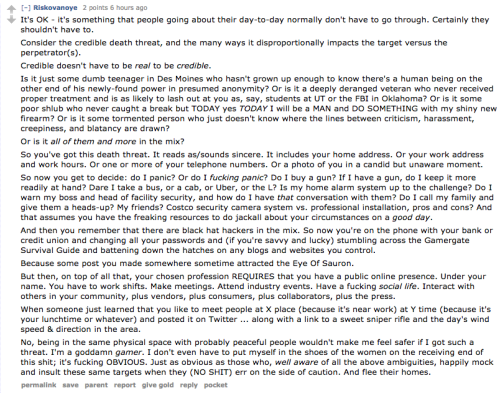
It is sometimes difficult to understand what makes a threat “credible” in relation to a dox. In order to be credible, a threat merely needs to inspire fear of safety by way of dox falling into the hands of people who may not be acting rationally or morally. The mindset of coming under credible threats is perhaps best outlined by this summation from a Reddit user (warning, NSFW language):
Creating this sense of panic is the typical end-goal of a doxing, but even if their intent is only to “harmlessly” ruffle your feathers, once the information is out there, it can pass under the nose of people willing to take it to new extremes. For this reason, it’s important to evaluate the information that they have gathered and the risks associated with that information in order to respond effectively. Any information pointing to your home address or financial information should be treated as a top priority, perhaps involving law enforcement if there are credible threats attached.
Responding appropriately can significantly reduce your stress and help you reclaim a feeling of control over your life. Focusing on hardening the areas they are attacking, and preventing them from ever finding the information they don’t have, can make the harassment you are receiving more bearable and prevent further escalation. Due to the crowdsourced nature of most online mobs and the bully mentality that drives them, “hard targets” are often quickly passed over.
Also, in evaluating your risk profile, the unfortunate truth is that online mobs are particularly vicious and persistent when their victim is a woman, LGBT (particularly trans), disabled, or belongs to a racial, ethnic, or religious minority. If you fit one or more of those elements the chances of someone acting on your dox increases substantially.
What follows is a cross section of the various kinds of information that diggers will collect, with a summary of how that information can be used:
Home address: The highest risk factor, home addresses often lead to unwanted food deliveries, magazine subscriptions, missionary visits, and COD products, and carries with it the risk of SWATing or physical stalking, harassment, abuse, or assault.
Finances/legal: Credit card numbers, banking information, social security numbers, anything of this sort should be reported immediately to the relevant institutions. Your bank, credit union, and law enforcement will recommend further actions you should take to protect yourself from further fraud and identity theft. Consider if your security questions could be answered by information now contained in your dox (like mother’s maiden name) and change it with your financial institution. Fortunately, these cases are rare, as harassment mobs try hard to avoid drawing too much scrutiny in order to prolong the harassment as long as possible, and openly committing credit card fraud is a great way to get federal agencies involved.
Work/School: Harassment that bleeds over into your workplace or school can be particularly stressful, as abusers will seek to have you sanctioned or even fired by way of mass false reporting. Even without a specific accusation, this harassment can place your job at risk as some employers may find that firing you is simply less trouble than dealing with the harassment. Particular professions, notably those that rely on privileged confidence or involve working with children, are especially sensitive to accusations.
Account Passwords: This becomes quite dangerous, especially if the account has access to reset other accounts or third party posting permissions. Often hijacked accounts are also used to impersonate you. Securing any compromised accounts should be a top priority, ideally adding two factor authentication to any account that supports it. If you suspect one of your accounts has been compromised, immediately attempt to recover it, change passwords, sign out all other sessions, and notify anyone who may have been contacted from it.
Social Media Handles: Social media is principally used as a vector for further harassment and as a source of additional information. Generally dumping this information is somewhat redundant, as harassers have typically already honed in on these public channels as a means of abusing targets long before a doxing. While stressful, this information doesn’t represent a serious breach in and of itself. If more sensitive information was readily available through your social media (such as a phone number on a poorly secured Facebook account) then that info would have been posted as well. Generally respond to these by bumping up privacy permissions, using an auto blocker, so on and so forth. Avoid clicking any suspicious links you’re sent from unknown people, as harassers may be looking for confirmation of your handles or attempting to get you to download malware.
Email: Typically this information will be used to send hatemail, signing you up for spam mailing lists, or using the address to register for embarrassing forums and services (filling your inbox with confirmation notices). A vulnerability that sets email apart from other social media, though, is that an email address that’s been used to sign up for lots of services, forums in particular, can lead diggers to additional information. Services such as Unroll.me and Mailstrom can help you quickly manage and unsubscribe from junk mail and clear up your inbox.
IP Address: This is often used to find a target’s physical location. While this sounds severe, and does require your attention, a home IP address is of limited use outside of that unless an attack goes unnoticed for a significant time. Check with your Internet Service Provider about changing your IP address – often this is a simple request.
Skype Handle: Skype handles should be treated with particular concern, as many cases we take at Crash Override stem from security holes in Skype and harassers using it as a vector to impersonate you to contacts, or single out said contacts for harassment themselves. Should this be the case, Microsoft thankfully offers live chat support (https://support.skype.com/en/faq/fa10656/what-is-live-chat-support) that allows a representative to freeze your account and return control over to you in short order. Additionally, linking your Skype account to a Microsoft account will allow you to enable two-factor authentication.
Biographical Info: What high school you attended, your sexual history, previous forums you visited, dumb things you said as a teenager; This is a catch all for information that isn’t directly useful, but can be used to embarrass, slander, or shame you. Details like these are also used by “diggers” to cross reference other information. Depending on the severity and nature of the information, this can translate from a quick episode of doxing to an extended slander campaign as harassers attempt to promote your dirty laundry, no matter how innocuous, untruthful, or irrelevant it may be, simply to get a rise out of you.
Phone Number: An especially obnoxious means of harassment, this will typically result in spamming you with text messages or harassing phone calls at all hours of the day. These may come from the abusers themselves, or from services that they may sign your number up for. In especially prolonged cases of harassment, the only means of alleviating this could be changing your phone number. However, law enforcement has an easier time investigating and prosecuting harassment by phone than it does harassment online, so be sure to document everything if you plan on going this route.
Deadnaming: Deadnaming is a particularly vile and callous form of direct harassment wherein the mob digs up and in some way weaponizes a target’s former name. This is most commonly (though not exclusively) used against transgender individuals, whose birth names can be a source of anguish, or even professional and physical danger. While other doxed information might be passed around for others to act on, harassers will often use a dead name to directly bombard a target to cause them distress. In some cases, we’ve seen things like harassers registering sockpuppet accounts with someone’s dead name and then following their friends on social media. Many social media networks do not consider this a violation of their TOS despite the direct intent to cause suffering, and we are advocating for more networks to address this issue.
Should I wait until I’m doxed to contact the police or family?
If you’ve been doxed (or fear being doxed), the natural extension of that fear is that tangible harassment is not far behind, more so if you’ve been targeted by a group with a history of employing SWAT calls or physical intimidation. Depending on how much information you have about the people targeting you, the police may be of limited use; if all you have is a premonition, they may not be useful at all. However, if the dox is surrounded by any sort of credible intent to follow up on your information, especially specific threats of assault, death, or fraudulent police reports, do not hesitate to contact your local police. We have produced a guide for talking to family and the police about online harassment, which you can find here: http://crashoverridenetwork.tumblr.com/post/113748237272/guide-talking-to-family-police
If the dox does not have any credible followup attached, this is not to say that the situation you are faced with is any less harrowing, or that people may not follow up on the dox. In this stage, self-care, informing relevant parties, and enacting personal security are safe and effective ways to regain control of your life.
Should I Go Offline?
One stubbornly persistent attitude about online harassment is that the victim can “just step away” or otherwise disengage at any point to stop the harassment being committed against them. This is patently false, and again, a victim-blaming tactic – once harassers have you in their crosshairs, their “win condition” is highly situational. Some seek to simply silence you, others to provoke a visible reaction, some to ruin your life and reputation or even cause you physical harm. There might not be a “correct” action in any case, and no guarantee that harassers will stop, especially while your dox are still accessible. If you do step away, it should be a personal decision enacted for reasons of self-care.
Stepping away from online spaces can feel like admitting defeat, like your harassers “won” and have driven you off the Internet; such is the psychological trap abusers intentionally create. Laying low for a while is no different than creating some distance in a high-friction relationship, or taking time off from a stressful job. You have the right to feel safe in social spaces, and you have the right to back away from those spaces.
We often find that cases that benefit from “stepping away” involve people who are targeted incidentally or don’t provide their aggressors with any “entertainment value” from being doxed, leading the mob to move on because of diminished returns on their harassment. However, this also encourages the same aggressors to return to doxing as a strategy any time they want to silence their target. Losing the attention of harassers in this fashion should be treated as an opportunity to harden defenses, such as removing dox from websites and taking countermeasures like registering for WhoIs privacy (all explained in our guide here: http://crashoverridenetwork.tumblr.com/post/108387569412/preventing-doxing), or in severe cases, changing things like phone numbers/emails/address.
In other cases, there is a fear that stepping away may cede a narrative to your harassers. This is usually when the harassment is taking the form of a prolonged campaign of libelous or embarrassing dox across social networks, as opposed to merely bombarding you with abusive emails, magazines, or pizza deliveries. These situations may be severe enough that they benefit from active monitoring to better ensure that you do not return to a reputation in tatters. Should this happen, do not feel bad about asking others to monitor your social media for anything worrisome – you should not feel forced to subject yourself to psychological abuse out of fear alone.
My dox contains my address/credible threats. Should I leave my home?
If you ever feel unsafe in your home, do not feel bad about choosing to vacate it for any length of time. It is not an overreaction to remove yourself from the potential of harm if there is good reason to believe your security may be compromised, and labeling your actions as such is a form of victim-blaming. It is your choice to make based on your own standards, beliefs, and justifications.
In extreme cases, law enforcement may even recommend leaving your home. If this is the case, they will oftentimes work with you, or at the very least dispatch offers to your location in a protective capacity.
Summation and Further Resources
As has been mentioned, this guide is meant to be a high-level informative primer on the realities, consequences, and considerations of being doxed. Attitudes about what to do and how to go about it can differ by culture, region, ethnicity, gender, and myriad other factors – but hopefully, this guide can give you a sense of direction or comfort in the current environment.
If you find yourself facing coordinated online mob harassment, we welcome you to contact us at crashoverridenetwork@gmail.com, in hopes that we can better direct you to appropriate resources, advice, and practical knowledge. No two cases are the same, and common wisdom can often be inapplicable to your particular climate of online discourse and moderation. You are the best judge of your own needs and circumstances, and our hope is to empower you to make informed decisions when the time comes. You are not alone.
One of the most frustrating aspects of dealing with online harassment is trying to accurately communicate what is happening to you to the people in your life in a way that they might understand. What seems like an all-consuming tidal wave of hostility and credible threats to someone who works online can seem trivial to people who don’t have that kind of relationship with the internet. We’ve assembled a few basic tips that we’ve found help the less tech-savvy people in our lives understand the very real toll of internet harassment, as well as some basic tips to get on the same page with the people in your life and law enforcement, in the event that you unfortunately need it.
Assess their tech literacy first. A too-common way to alienate someone you’re trying to talk to about online harassment is to overwhelm them with terms and concepts, especially if you’re stressed or panicking. If you’re unsure, try to gauge their familiarity with the technology and services the harassment is taking place on, or how much they know about the internet in general. If you’re someone who spends a lot of time online, it can be easy to forget how people could ever live without it.
Don’t overuse jargon. Ever see those scenes in Star Trek where they’re talking about a specific engineering malfunction and using made up words to be really specific? To some people, that’s what it sounds like when you try to explain internet culture. Not everyone knows what Twitter is, much less what it’s for or the cultural norms of using it. Instead of talking about the particulars right off the bat, start with a summary, focusing on what these terms and concepts might *mean* instead of the nitty-gritty blow-by-blow. You can always go into further detail later. Try to find common ground when you can with devices like metaphor or shared experience – the goal is to arrive on the same page, rather than just dump a bunch of information on their head and hope they can make sense of it.
Stress what the internet means for you. A lot of people who do not participate in any facet of internet culture may not understand what the big deal is, and a simple way to convey that is to tell people *why* these services are important to you. Social media is often a major support network for a lot of people, if you do any sort of work and self promotion online it’s a vital part of your workplace, and talking in these relatable terms can make it easier for people to grasp what is happening to you. If it’s applicable to your situation, it helps to have links to major publications that describe the form of harassment you’re facing, especially if an article deals with the same controversy you’re embroiled in. Mainstream sites like the New York Times and The Verge have covered these topics. This may elevate the import and seriousness of what you are talking about to those unfamiliar with what you may be facing, and makes it less likely that family or friends may brush it off.
Sometimes it just won’t happen. Some people are staunchly uninterested in anything having to do with the internet, and may be the type to dismiss you on that alone regardless of what’s actually happening in your life. It’s important to not blame yourself for this – cultural attitudes toward tech are a thing bigger than any single person, and ingrained ideas do not change overnight. It’s important for your own self-care to make sure that you’re not fighting a battle you can’t win – do not be afraid to disengage and agree to disagree when this is the case, where possible. This is, of course, more tricky in situations when you are dependent on the party who might now face tangential harassment from the people targeting you such as when asking a former employer not to give out your information, or when talking to roommates or parents after being doxed. In those cases, it can be helpful to set aside the justifications and simply ask if they can co-operate with what you’re asking of them.
Common sentiments you may find thrown your way, and some sourced counterpoints that may help:
The internet is “real life”. We watch Netflix instead of television, use Google Maps instead of paper maps and send Facebook messages or emails from our mobile devices when we need to get in touch with someone. Making the distinction between the two is silly in 2015.
There is a larger problem of harassment on the internet. Fully 73% of adult internet users have seen someone be harassed in some way online and 40% have personally experienced it (source: http://www.pewinternet.org/2014/10/22/online-harassment/)
A thing to keep in mind is that other people behaving poorly and crossing lines is *not* your fault. You cannot control the actions of others, only your own, and no action should result in widespread harassment. What we are talking about is not being subject to mere criticism, but having your personal boundaries violated or your safety and well-being threatened in a credible and tangible manner. Everyone has a right to be online without having to experience this.
“Can’t you just call the police and leave it at that?”
Dealing with it. It can be profoundly frustrating to not only have to deal with being harassed by a mob, but then have the people in your life struggle to understand what’s even happening to you. Again, make sure you’re caring for yourself, and not taking the blame for cultural attitudes or tech illiteracy that you cannot control. If need be, please contact us at crashoverridenetwork@gmail.com for further assistance, or consider using another service such as 7cupsoftea.com.
Talking With Police
***IF YOU BELIEVE YOU ARE IN IMMINENT DANGER, PLEASE IMMEDIATELY CALL 911 OR YOUR LOCAL EMERGENCY LINE***
The following advice is based off of law enforcement practices in North America. We will update with an additional guide on other countries & international law if and when we have enough of a knowledge base.
Navigating the world of law enforcement can be tricky for anyone, but talking to police about things that happen online can be a whole new level of frustration. Many people don’t have experience with filing police reports, or even talking to the police at all. This is doubly intimidating when dealing with online mob harassment, in which case there are (in most cases) no names, places, or jurisdiction to report on. However, you may end up wanting to speak with the police for any number of reasons, whether that be establishing a paper trail or tipping them off to credible threats to your safety, which they can oftentimes understand in general terms.
When is the right time to call? Sadly, there is no one “correct” answer to all situations. As stated above: if you are in immediate danger, please call 911.
The legal system can be a complicated thing to understand. There is an important difference between criminal matters and civil matters that a lot of people aren’t well versed with. Criminal cases are considered offenses against the state, and the prosecutor works with the police (not the victim) to file the case in court as a representative of the state. A civil cases are disputes between individuals where the plaintiff is trying to get the defendant to right a wrong, usually through compensation. What this means is that a situation where someone is slandering you or trying to ruin your reputation falls more into the civil category, whereas someone sending you threats would be committing a criminal offense. In the case of harassment, it could be both criminal (someone broke the law by sending you threats) AND civil (which caused you some kind of harm you are asking compensation for), but it’s all highly situational.
Police only handle criminal cases. For civil cases, consider contacting a lawyer through a service like avvo.com to get advice on how to proceed – a lot of them will offer free consultations. Some states have restraining orders or abuse prevention orders that apply to online contact, which can be helpful to people dealing with chronic abusers. While these sorts of court orders are generally handled as civil matters, often they require a police report as well.
Police departments can have widely different reporting procedures across the US. Some will send officers to you, some require you fill out paperwork in person, some have online forms for things like prank calls. The best way to find out your local PD’s procedure is to call the non-emergency line and ask about filing a police report.
Outside of that, there are a lot of considerations. Before contacting the police, it’s good to have a goal in mind. Do you want to establish a record of what’s happening to you? Are you afraid of being SWATted? Do you want to get a restraining order? Knowing this ahead of time can help you ask the right questions of the police, and make it easier to handle the situation properly. The trauma of talking about the abuse you’re facing, combined with the anxiety of talking with cops in general can be a nasty combination to have to fight through, and preparation can help you be more effective at handling the situation. Consider even looking at a sample police report to see what kind of information they might be asking of you. Try to think through your answers to these questions before calling, and keep them fresh in your mind. If you feel like it might help, write your planned responses down beforehand so you can keep your composure.
If you decide to contact the police, research your local police department. Find out whether they have detectives who are assigned to online issues. Try contacting them directly, if possible, but if the situation seems urgent, contact an officer who is on-duty and ask them if they can send a copy of their report to the detective or division which seems to cover these issues, if any.
If you are aware of where a particular person who is harassing or threatening you lives, first file a police report with your local police, then also file a second report with the law enforcement agency where that person lives. Be sure to give them the contact information of the officer assigned to your case, as well as the case number (if you have one.)
You may also want to file reports not only with your local police department, but with state authorities (likely your state attorney general’s office or state-level bureau of investigation), as well as with federal law enforcement. On the federal side, you can contact your local FBI office and file a report online at http://www.ic3.gov/.
Restraining & Abuse Prevention Orders
Restraining orders are intended to prohibit imminent harm. The availability and processes of obtaining a restraining order vary from state-to-state. If you’re unsure whether or how to get a restraining order, you may want to contact local domestic violence organizations, or contact the clerk of your municipal or state court to see whether they can refer you to an organization that can help you prepare a restraining order. While most restraining orders are filed without the assistance of an attorney (and judges usually understand that the people filing them may not be familiar with the legal process), it may be helpful to talk to an attorney to help you prepare a restraining order petition or to represent you at any hearings.
However, keep in mind that because restraining orders are intended to prevent imminent harm, you shouldn’t wait to file one. A judge is less likely to issue a restraining order based on what happened to you last month or last year if the person you’re seeking it against hasn’t contacted, threatened, or abused you since then. If you’re unsure, talk to someone!
If you’ve filed a police report, ask the officer whether you should seek a restraining order, or if they can grant you an Emergency Protective Order (if your jurisdiction has this.) If they say that you should, include this fact on your restraining order petition.
If you’ve filed for or received a restraining order, follow through with it. Go to any hearing. If it’s violated, report the violation to your local police department (and to the police department where the other person lives). If the restrained person lives in another state, report violations to local police in both places and to the FBI.
What sort of harassment are you receiving?
There isn’t much the police can do with someone telling you they wish you would drop dead, but if they use details like time and place they can work with you to address your safety concerns. If you have already been doxed, and the person sending you threats has your address or physical location, be sure to mention that. If you’re receiving harassing phone calls, law enforcement is a lot better equipped to deal with that and can act on those calls with more ease than they can act on web-based harassment.
Do you know who is abusing you?
When you file a police report, one of the first things you may be asked about is the identity of your abuser. It’s very difficult to get much done when you have no idea who is doing it, as the police will rarely go out of their way to do things like trace back IP addresses or work with social media. The more details that you can provide about who is doing this to you, the better.
Are the people you’re reporting in the same jurisdiction as you?
Location matters more than you might think. There is frustratingly little a local police department can or will do about abusive people from outside your state, and when you’re dealing with online abuse that is a major problem. If this happens, however, you still need to file a report with your local police department first before much can happen on a federal level – in the event that you do manage to get the FBI interested, they need this report to work off of first. If you are filing a report because you’re seeking a restraining order or abuse prevention order, under the federal Violence Against Women Act (which also applies to male victims), jurisdictions must give full faith and credit to valid orders of protection. Full faith and credit is a legal term that means that jurisdictions must honor and enforce orders issued by courts in other jurisdictions – so your order will apply across state lines.
When did this occur?
Be sure to have specific dates and times on hand for any incidents you are specifically referencing. The legal system runs on details like this, and you’ll save yourself some time and stress by writing down exactly when things took place.
Miscellaneous Advice:
Document everything. For evidence purposes, make sure you archive and backup everything in multiple ways (screenshots, PDFs, and, if possible, tools that can be independently verified, like archive.today or web.archive.org) with a visible URL and date/timestamp where possible. These details are vital if your case ever goes to trial or investigation.
Bring in printed screenshots, not CDs or thumb drives (unless you are submitting audio/visual evidence, in which case thumb drives may be permissible – even still, see if there’s a way you can play such evidence back to a providing officer for use in a report). The easier you can make it for the police to view exactly what you’re talking about, the easier it will be for them to understand what to do with it. Make sure that you have all of your evidence backed up and are not giving the police the only copy – it’s easy for things to get lost in the process.
It may be helpful to organize your documents by keeping a journal. Who said or did what? When did they do it? How did you respond? Where can someone reading the journal find evidence of that conduct? This can be helpful not only in establishing a record of continuous conduct, but in exercising your feelings.
Remember to follow the above tips about describing your internet life in layperson’s terms. Save specifics for when the report is actually being written and don’t overwhelm the officer with details immediately – they will ask you questions when they’re ready, and it’s good to keep your answers simple unless specific details are needed. Consider writing down a concise, high-level statement of what you’re facing ahead of time, like “A group of people have been sending me death threats online”, “A website is hosting pornography of me without my consent”, or “Someone is planning on prank calling 911 to fraudulently claim that I am holding people hostage in the hopes that a SWAT team will be dispatched to my home, and I wanted to give you advance notice.”
Police reports are the first step in the chain of law enforcement’s involvement on any level, and having one for your records can be useful down the road, even if it seems extreme in the moment. Police are always obligated to take a report from you. If they seem hesitant or dismissive, just explain that you would like one for your records and are establishing a paper trail in case you need one later.
Don’t worry if your police report omits or confuses minor details, especially in complicated and lengthy harassment episodes – the officer on duty may already have a hard time parsing the evidence and will likely be primarily concerned with the overall threat and major events. The purpose of a police report is to create a point from which investigators can look into your case. An investigator should contact you if this is the case, and they are the people you’ll want to show everything to.
The level of cooperation and understand of your local police department can be dependant on the nature of the officer on call to take your report that day. Some are more internet savvy or empathetic, other may be more glib, and their attitude can be affected by everything from the complexity of your situation to your gender or ethnic background. Remember that in keeping the nature of your harassment relatable and the jargon to a minimum, your chances of getting a cooperative and accurate police report without issue are much greater.
Different police departments will have different rules for obtaining copies of your report – some will give you one before you leave if you go in person, others will request you write-in for a copy a week after you file. Make sure you know your local PD’s protocols if you need to file a report, and don’t be afraid to ask. Ask for a business card from the officer if need be, as they will typically be happy to provide one. Police reports are created and then occasionally escalated to a detective if there is anything they can act on. Often they tell you that they’ll follow up with you in a few days if you’re not in immediate danger, but they forget sometimes. Don’t be afraid to call back and keep your case number somewhere safe.
Swatting
More people than ever are aware of, and worried about, being swatted. This is highly uncommon in situations where people have not been doxed, and you likely do not need to take action unless you are currently being specifically targeted. SWATing tends to happen post-dox, and while it can happen to anyone, it is more commonly used against celebrities and people who are involved with politics, tech, or gaming. While the police always have to respond to calls where someone is in danger, calling them ahead of time can help de-escalate the situation if you’re lucky. Again though, this all comes down to who is sitting at the desk when your call comes in, but we have seen this work in the past.
While it is our hope that you will never have to deal with the eventuality of a SWATing, there are a few things worth knowing if the worst should come to pass.
If you believe a SWAT is imminent and have any dogs, lock your dogs into a crate (if you have one) or in your car. If the officers can see the dogs are contained they will typically leave them alone. Do not lock them in a room/closet as officers will clear all rooms, and when they open the door in a heightened state of alert, they are more likely to react negatively. Too often, dogs are casualties of overzealous SWAT teams, and keeping them locked up reduces the risk of an officer harming them.
During the first minutes of a SWAT raid, do not try to explain/talk to the cops. Let them determine they are in a safe place first, and that there is no present danger to anyone, then speak calmly to the team leader. Ask for him/her with a simple “Can I speak to your Team Leader?”.
—
If you have any specific legal concerns, please contact your local police department or seek legal counsel from an attorney that specializes in what you’re facing. This guide is by no means exhaustive or the definitive authority on an evolving and complicated subject, and simply seeks to disambiguate a stressful process and share tips from people who have already been through it.